
SUSTAINABLE GARDEN DESIGN
As Garden Designers, we are continually assessing how we can minimise carbon emissions when building gardens. This is a big subject, so we’ve focussed on three themes that relate to the construction process and the choice of hardscaping materials. It’s not as dry as it sounds, we promise! And we’ve tackled sustainable planting as a separate article.
THE GARDEN BUILD – RECLAIM, RECYCLE AND RE-USE
Re-use, re-use, re-use! Creating as little waste as possible in building the garden will help to reduce carbon emissions, so re-using what you already have can make a big difference. Existing paving slabs can sometimes be salvaged, for instance – cleaned up, re-cut and re-configured can give them a new lease of life. Or, if you are bringing new material onto site, consider sourcing reclaimed. This serves to add to the character of the garden, as a vintage piece of furniture does to an interior.
Transporting material on and off-site undoubtedly adds to carbon emissions and also to the financial cost. Consider reusing excavated soil on site, as this can account for much of the ‘spoil’ removed. For instance use the soil excavated from digging a pond to create sculptural landform or a planted bank. Hard materials that you no longer need can also be reused – unwanted bricks or concrete slabs for instance can be broken up to create a base for a new path or terrace – and this saves the cost of bringing shingle onto site. This isn’t always possible of course, especially on small sites, but it’s something we consider from the off..
HARD LANDSCAPING AND CARBON FOOTPRINT- LESS IS MORE
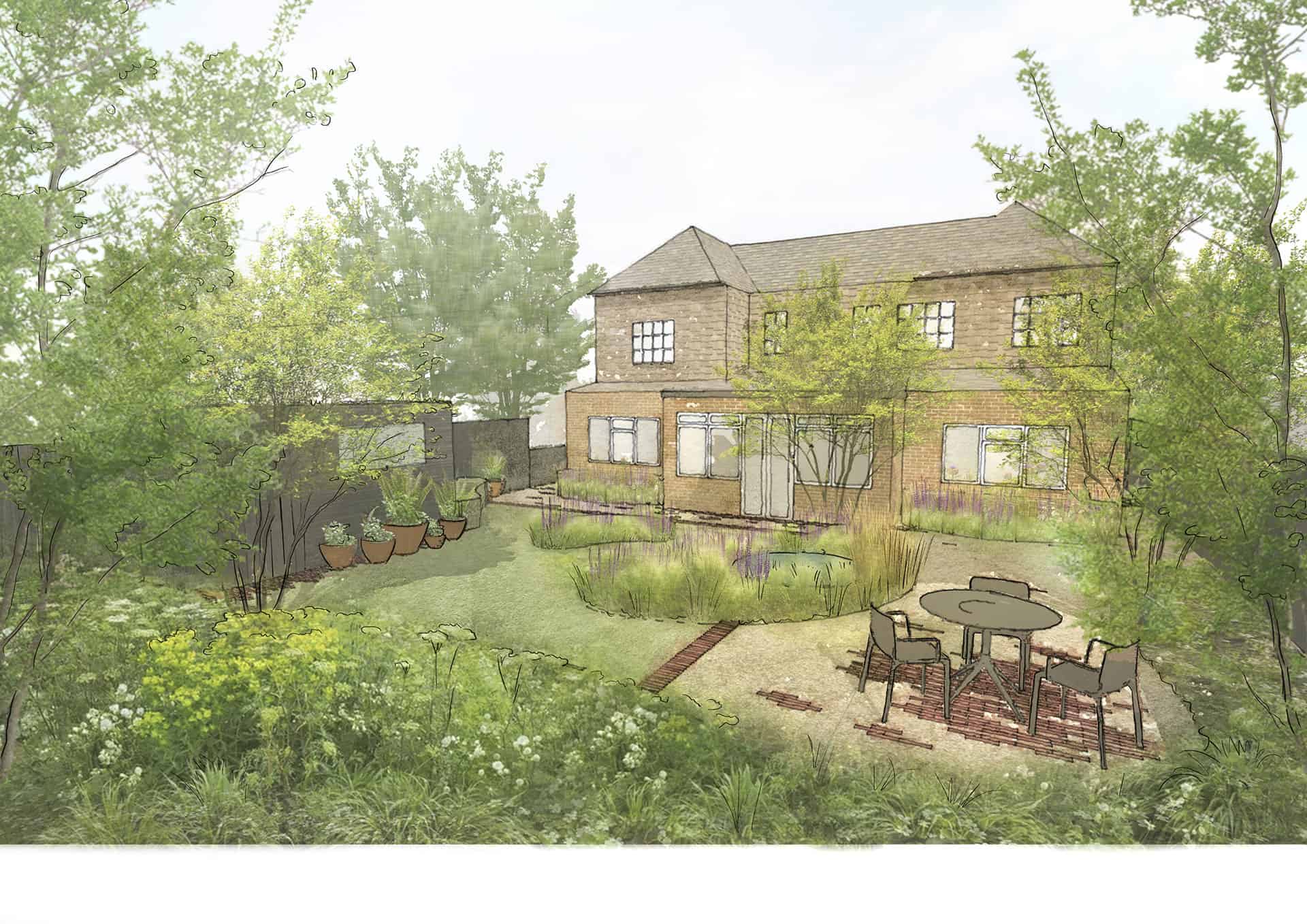
Hard materials – brick, stone, concrete, porcelain and the like – can carry a high carbon footprint, so it’s important to consider what you’re using and where. We revisit these questions throughout our design process, thinking about which areas really need area of hardstanding – where our clients will sit or dine for instance – and where they require walkways and paths – for instance there may be scope to use brick as an ornamental detail within a gravel path rather than as the primary building material.
CHOOSING SUSTAINABLE HARD MATERIALS
Not all hard materials are created equal in terms of carbon footprint. Gravel – itself a waste material from quarrying – comes out pretty favourably, requiring less processing and less transportation than stone, as it can be sourced regionally. For stone, much depends on where it is transported from – for instance York stone, quarried in the UK, will have a much lower carbon footprint than, say, Indian sandstone. Natural however doesn’t always mean ‘better’ – the quarrying process itself is after all detrimental to the environment – so it’s worth considering man-made paving alternatives too. Porcelain and concrete each come with their own pros and cons. Both require carbon intensive manufacturing methods (excessively high heat) and the jury’s still out as to whether this is offset by their manufacture closer to home. This is arguably an oversimplified explanation, but hopefully it gives a flavour of the conundrums!
Timber generally has a lower carbon footprint than most hard materials, due to the fact that tree sequester carbon as they grow, and it does not require high-energy processing. We’ve read that replacing a cubic metre of concrete with timber can save a tonne of carbon dioxide emissions – isn’t that incredible? However tropical hardwoods – used outdoors due to their resilience – have not only been transported a great distance, but often come from areas of de-forestation. For this reason, it’s worth looking at timber reclamation yards as an alternative source – we recently specified tropical hardwood railway sleepers to make chunky steps and garden benches for instance. These are just as hard wearing as buying new, but with a lower environmental impact.
KEEP IT PERMEABLE AND CREATE A RAIN GARDEN
With increased storms and rainfall during the Autumn and Winter, many parts of the UK suffer regular flooding. Non-permeable materials like concrete and tarmac contribute to this; they create ‘run-off’ which often overwhelms our drainage systems. Whereas gravel for instance is permeable, allowing rainwater to be absorbed into the soil beneath and released back into the atmosphere slowly through evaporation. Plants will absorb excess water, their roots act like sponges, so increasing the amount of planting next to terraces and driveways can help alleviate ‘run off’. Many plants love wet conditions and can be used as both a functional and beautiful element of the garden.
There’s no doubt about it, selecting hard materials with low carbon footprint is complex. For us, it’s a case of striking a balance and choosing and using materials with care; prioritising a ‘local’ supply chain where possible can really help. A carbon calculator is a useful tool in understanding the carbon footprint of a project, in assessing ways to reduce it, and in calculating how long the trees and plants will take to offset the carbon generated. These tools are still evolving within the industry and we hope their accuracy will improve over the coming years.
The good news is that – despite all these considerations – gardens can do a great deal of good for the environment. For more about the positive impact of planting – and how to maximise this – please read our article Planting to save the planet).